The skirret is an especially interesting subject for Masonic education because it connects the practical work of the operative stonemason with the moral and philosophical lessons of speculative Freemasonry. It also raises a worthwhile historical question: why does this tool appear in the symbolism and ritual of some Masonic traditions, particularly those influenced by British workings, but is generally absent from the standard ritual of American Craft Masonry?
Among the working tools of Freemasonry, some are immediately recognizable to nearly every Mason: the twenty-four-inch gauge, the common gavel, the square, the level, and the compasses. Others, however, are less familiar, particularly to Masons working within the American ritual tradition. One such instrument is the **skirret**, a tool associated with the Master Mason’s Degree in English Freemasonry and one that carries a particularly meaningful lesson about moral direction, preparation, and the establishment of a sound foundation.
The skirret is seldom encountered in American Craft Masonry, where the trowel traditionally occupies a prominent place among the working tools of the Master Mason. Yet the absence of the skirret from American ritual does not diminish its symbolic value. On the contrary, studying this relatively unfamiliar instrument offers an opportunity to explore the relationship between operative craftsmanship and speculative Freemasonry, as well as the historical differences that developed between British and American Masonic traditions.
To understand the skirret, we must first understand what it does, how it came to be associated with Freemasonry, and why its practical function provides such a compelling lesson for the Mason who seeks to build a life upon sound principles.
The operative purpose of the skirret
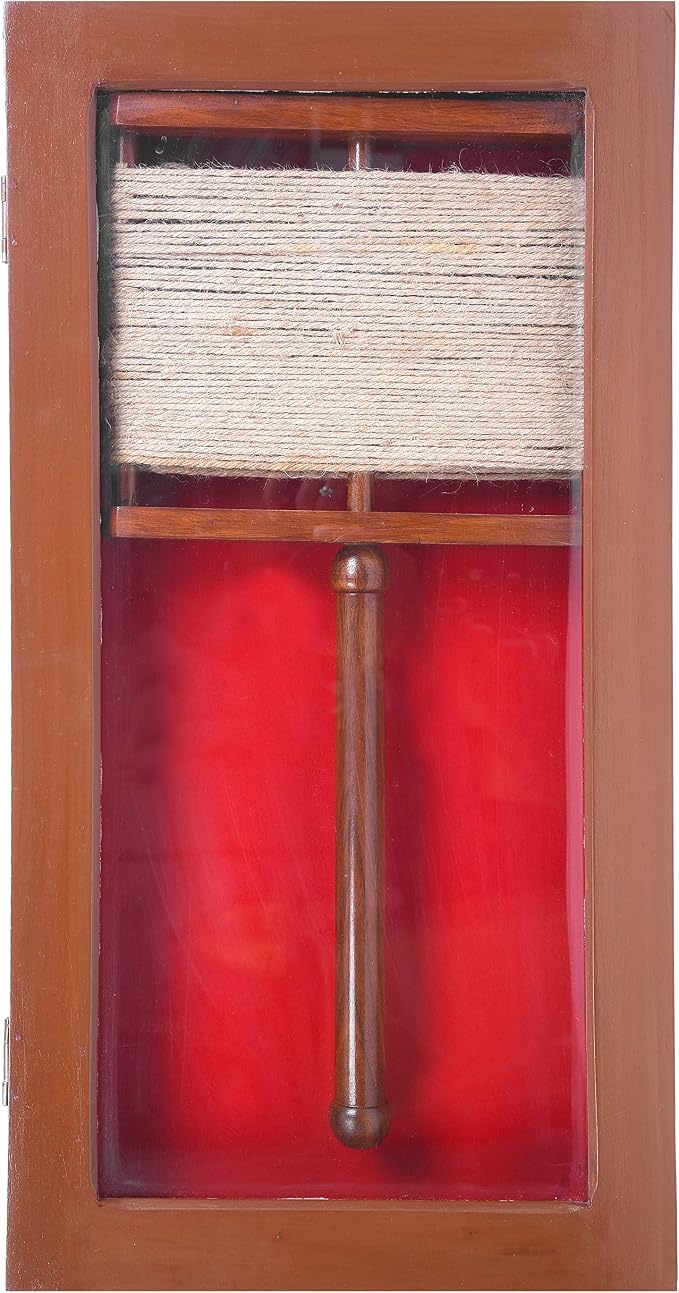
The skirret is a setting-out instrument used to establish straight lines when laying out a building or marking the boundaries of a construction project. In its traditional form, it consists of a central pin or point around which a line is arranged on a reel. The line can be extended from the fixed point, stretched across the ground, and snapped or marked to establish a straight reference line. By using such lines, a builder can determine the position and alignment of a proposed structure before construction begins.
In this respect, the skirret belongs to the preliminary stages of building. Before stones can be laid, walls raised, or architectural details completed, the builder must establish where the structure will stand and how its principal dimensions will be arranged. An error at this early stage can affect everything that follows. A foundation incorrectly positioned or laid out of alignment may compromise the entire building, no matter how skillfully the individual stones are prepared.
The skirret therefore represents a stage of work that precedes the visible achievement of construction. It helps establish the lines by which subsequent labor is guided.
There is, however, an important historical qualification. Although Masonic explanations often describe the skirret as an operative mason’s tool, research into its history suggests that the instrument, as understood in modern Masonic symbolism, was not a standard tool of medieval stonemasons. The Chipstone Foundation’s study of American Masonic furniture notes that the word appears to have been adopted by British Freemasons in the early nineteenth century, with the earliest known Masonic use identified in a letter dated September 24, 1816. The precise origin of the name remains uncertain. The implement itself resembles a chalk line, a practical device used to establish straight lines in building and other trades.
This distinction is worth preserving. Freemasonry frequently draws moral instruction from tools associated with building, but not every tool appearing in Masonic ritual can be confidently traced to the working practices of medieval operative lodges. The skirret’s historical importance lies in its eventual adoption into Masonic symbolism, regardless of whether its ritual history can be carried back to the medieval craft.
 The skirret in English Freemasonry
In the English system, the skirret is associated with the working tools of the Master Mason. It is traditionally presented alongside the pencil and compasses, although the precise list of working tools can vary among English rituals and workings. Together, these instruments suggest the work of the designer and master builder: establishing the lines of a structure, recording the plan, and determining its limits and proportions.
The familiar explanation of the skirret assigns it a moral meaning: it points to the straight and undeviating line of conduct laid down for our guidance in the Volume of the Sacred Law.
This interpretation transforms a practical instrument into a guide for the moral life. The line drawn across the ground becomes a metaphor for the principles by which a person ought to direct his conduct. Just as the builder requires a reliable reference line to establish the position of a wall, the Mason requires a dependable moral standard by which to judge his decisions.
The symbolism is not merely about remaining on a straight path. It is also about determining that path before proceeding. A builder does not begin laying stones and only afterward decide where the wall should stand. The line must be established first. Likewise, a Mason who wishes to live honorably must consider the principles that will guide him before circumstances, temptations, or personal ambitions begin to dictate his choices.
The Volume of the Sacred Law supplies the traditional religious and moral reference point in this explanation. For the Mason, it represents a source of instruction concerning duty, conduct, and the obligations owed to the Divine and to fellow human beings. Its teachings provide a standard against which the individual may examine his actions.
The skirret thus reminds us that moral conduct is not something to be improvised whenever a difficult decision arises. It requires a guiding principle, a willingness to consult that principle, and the discipline to remain faithful to it.
Why the skirret is generally absent from American Masonry
The question of why American Masons generally do not encounter the skirret in their degree work cannot be answered simply by saying that the tool was forgotten or that American Freemasonry rejected its symbolism. The more convincing explanation lies in the historical development of different Masonic ritual traditions.
Freemasonry developed on both sides of the Atlantic through related but distinct ritual histories. Although American Freemasonry inherited much from British Freemasonry, the working tools and their explanations were not preserved identically in every jurisdiction. Over time, the rituals used by American Grand Lodges established their own customary arrangements and interpretations.
One of the clearest differences concerns the working tools of the Master Mason. In the commonly used American system, the trowel is the principal working tool associated with that degree. In the English tradition, the skirret, pencil, and compasses are commonly identified as the working tools of the Master Mason, with the trowel also included in some workings. The English and American approaches therefore emphasize different symbolic groupings.
This difference is significant because the trowel communicates a lesson particularly suited to the American presentation of the Master Mason’s working tools. It is used to spread mortar, binding separate stones into a unified structure. Speculatively, it represents the spreading of brotherly love and affection, by which Masons are united into one brotherhood. Its symbolism emphasizes the relationship between individual Masons and the bonds that hold the fraternity together.
The skirret, by contrast, emphasizes the establishment of a straight line of conduct. Its lesson concerns personal direction, moral consistency, and the principles that guide one's actions. These teachings are not contradictory. They address different aspects of the same Masonic undertaking: the skirret suggests how the individual should establish his course, while the trowel reminds him of the affection and unity through which the brotherhood is cemented together.
Why, then, did the skirret not become a standard part of American ritual? The available historical evidence supports a conclusion about ritual divergence, but it does not establish a single documented decision by American Masonic authorities to exclude the tool. It is more responsible to understand its absence as a consequence of the different working-tool traditions that became established in Britain and America, rather than to attribute it to one specific historical event.
The skirret's relatively late appearance in documented British Masonic symbolism also cautions against assuming that it was an ancient instrument universally known to the Craft and subsequently lost in America. Its ritual use developed within a particular tradition. American Freemasonry followed a different path in presenting the working tools of the Master Mason, and the trowel became its customary emblem.
The distinction is therefore one of ritual inheritance and emphasis, not a measure of the worth or depth of either tradition.
The symbolism of the straight line
The skirret's most direct lesson is the importance of a straight and undeviating course of conduct. Yet the symbolism becomes richer when we consider what a straight line actually represents in the process of construction.
A line provides direction. It establishes a reference against which other measurements can be made. Without it, the builder has no dependable basis for determining whether the work is aligned as intended. The line does not construct the building by itself, but it gives the builder a means of judging whether the construction follows the plan.
In the same way, a moral principle does not automatically make a person virtuous. Knowing what is right and doing what is right are separate matters. A Mason may understand the teachings of his ritual, quote the obligations of his degree, and speak eloquently about honor and integrity, yet still fail to apply those principles when they become inconvenient.
The skirret invites us to move beyond the possession of knowledge toward its practical application. It asks whether the principles we profess actually guide our conduct. Do they influence our dealings with our families, our fellow Masons, our colleagues, and those from whom we expect nothing in return? Do we remain faithful to them when doing so requires patience, sacrifice, or the admission that we have been wrong?
A straight line is not established by wishful thinking. It must be deliberately drawn. Likewise, integrity is developed through repeated choices, especially those made when no one is present to praise or criticize us.
The tool also suggests that consistency matters. A builder cannot establish a reliable foundation by changing the reference line whenever the measurements become inconvenient. A Mason cannot maintain a sound moral character if his principles shift according to the company he keeps or the advantage he hopes to gain.
The skirret therefore serves as a reminder that the moral life requires both knowledge and discipline: knowledge to recognize the right course, and discipline to follow it.
Establishing the foundation before building
The skirret is particularly instructive because its work occurs before the structure rises from the ground. It belongs to preparation, planning, and the establishment of direction.
This offers a natural comparison with the speculative Mason's own life. Before undertaking an important responsibility, accepting a leadership position, or beginning a demanding personal endeavor, we benefit from asking what principles will govern our decisions. Without such reflection, it is easy to become occupied with activity while losing sight of the purpose behind it.
Freemasonry repeatedly reminds us that the work of improvement begins within ourselves. The rough ashlar provides an image of the individual whose character is still being shaped. The common gavel represents the removal of imperfections. The square teaches uprightness, while the level reminds us of our common standing as human beings. Each tool offers a different perspective on the work of self-improvement.
The skirret complements these lessons by directing our attention to the line along which that work should proceed. It asks us to establish the moral orientation of our lives before we begin adding the stones of achievement, reputation, knowledge, or authority.
A man may accomplish much and still construct a life that is poorly aligned. He may accumulate honors, attain positions of responsibility, or become admired for his achievements, yet neglect the principles that should have governed his progress. The skirret reminds us that a structure's outward appearance cannot compensate for a faulty layout.
The question, then, is not simply whether we are building something with our lives, but whether we are building it in accordance with sound principles.
The skirret and the discipline of self-examination
There is another important aspect of the skirret's symbolism: a line provides a standard against which deviation can be recognized. Without a reference point, it may be difficult to know whether the work has strayed from its intended direction.
For the speculative Mason, this suggests the value of regular self-examination. It is easy to notice the faults of others while remaining unaware of our own inconsistencies. We may judge another person's words harshly while excusing our own, demand fairness while acting out of prejudice, or speak of brotherhood while allowing resentment to influence our behavior.
A moral standard is valuable precisely because it does not change to accommodate our preferences. It allows us to recognize when our actions fail to reflect our professed principles.
This does not mean that the Mason must imagine himself incapable of error. On the contrary, the practice of self-examination begins with the recognition that every person is imperfect. The objective is not to claim that we always follow a straight course, but to recognize deviation honestly and make the necessary correction.
The skirret, as a symbolic instrument, can therefore be understood not only as a guide but also as a means of evaluation. It calls us to compare the lives we lead with the lives we aspire to lead.
Such examination should not become an exercise in self-condemnation. Its purpose is constructive. A builder who discovers that a line is out of alignment has the opportunity to correct the layout before proceeding. Similarly, the Mason who recognizes a failure of patience, honesty, or charity can use that knowledge to improve his future conduct.
The important point is that correction becomes possible when we are willing to acknowledge the standard and measure ourselves against it.
A tool that remains useful even when it is absent
It might be tempting to conclude that American Masons are missing an important lesson because the skirret does not ordinarily appear in their ritual. Such a conclusion would be too simplistic. American Freemasonry teaches many of the same moral principles through other symbols, charges, and obligations. The absence of one instrument does not mean the absence of the virtue associated with it.
Nevertheless, the skirret offers a useful opportunity for Masonic education precisely because it is less familiar. Studying a tool from another ritual tradition encourages Masons to look beyond the particular arrangements of their own degree work and consider the broader symbolic language of the Craft.
The instrument can be introduced in a lecture, educational paper, or discussion without suggesting that a lodge should alter its established ritual. Its value lies in the reflection it encourages. It reminds us that the Masonic tradition contains a rich diversity of working tools and interpretations, some of which may illuminate lessons that we already encounter through familiar symbols.
The skirret also provides an opportunity to distinguish between ritual uniformity and shared purpose. Freemasons may receive different explanations of certain tools, yet still recognize a common commitment to moral improvement, brotherly love, relief, and truth. The language and instruments may differ, while the underlying work remains recognizable.
The skirret may be unfamiliar to many American Masons, but its symbolic lesson is both simple and enduring. Before a builder raises a wall, he establishes the line that determines where the wall will stand. Before a Mason can hope to build a life of integrity, he must establish the principles by which his conduct will be directed.
The instrument reminds us that character is not formed by ambition alone, nor by the accumulation of knowledge, honors, or Masonic titles. It is formed through the consistent application of sound principles to the ordinary decisions of daily life. The straight line must be drawn, consulted, and followed.
Its absence from standard American Craft ritual reflects the different histories of British and American Masonic practice, particularly the contrasting working tools associated with the Master Mason's Degree. It does not suggest that American Freemasonry lacks the moral lesson the skirret conveys. Rather, the tool gives us another way to examine a familiar responsibility.
Every Mason, regardless of jurisdiction, must decide what principles will guide his life and whether he has the discipline to remain faithful to them. We may use different tools to express that responsibility, but the task itself is unchanged.
The skirret reminds us that the work of building a better man begins before the first stone is laid. It begins when we establish the line of conduct we intend to follow—and when we resolve to measure our actions against it.
References for further study
- Albert G. Mackey, *An Encyclopedia of Freemasonry and Its Kindred Sciences*, entry on “Skirret.”
- Harry Carr, *The Freemason at Work*, discussion of the origin and Masonic use of the skirret.
- James A. Marples, “The Mason’s Skirret,” an article discussing the tool’s practical function and symbolic interpretation.
- Chipstone Foundation, “Admitted into the Mysteries: The Benjamin Bucktrout Masonic Master’s Chair,” which discusses the historical evidence for the skirret and differences between English and American working tools.


