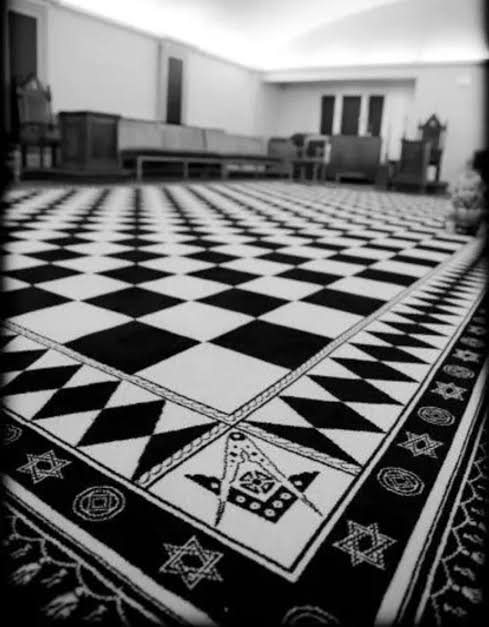
Few images are as closely associated with Freemasonry as the black-and-white chequered floor at the center of the Lodge. It is among the first symbols encountered by the Entered Apprentice, and it is often one of the most recognizable features of a Masonic temple to those outside the Craft. Yet, despite its familiarity, the Mosaic Pavement has a history more complex than its simple appearance might suggest. Its origins have been associated with Moses, the Temple of King Solomon, the practical work of operative stonemasons, the tracing practices of early Lodges, and even the ancient Greek Muses. Its meaning has likewise developed from a practical instrument of construction into one of Freemasonry's most enduring representations of the human condition.
The Mosaic Pavement is neither merely Masonic decoration nor a static symbolic ornament. It is a reminder of the world in which we live, a world of contrasting conditions, competing forces, changing fortunes, and apparently irreconcilable opposites. Black and white, light and darkness, good and evil, life and death, progression and regression: all occupy the same field. The pavement does not eliminate these oppositions, nor does it promise that they will eventually disappear. Instead, it presents them together, inviting the Mason to examine the conditions of existence and his own place within them.
To understand this symbol fully, we must consider several dimensions of its development. The historical evidence helps distinguish early Masonic practice from later traditions about biblical architecture. The etymology of the word mosaic corrects a persistent misconception concerning Moses. The geometric arrangement of the pavement raises questions about proportion, measurement, and the relationship between the visible world and the principles by which it is understood. Finally, differences in ritual practice reveal that the pavement can be approached both as a representation of the world to be contemplated and as the very ground upon which Masonic obligations are undertaken.
These historical, practical, and philosophical dimensions are not mutually exclusive. Together, they show how a working instrument can become a symbol, and how a symbol can continue to guide reflection long after its original practical function has been transformed.
Where Does the Mosaic Pavement Come From?
The origins of the Mosaic Pavement in Freemasonry cannot be established through a single historical event or an unbroken record of development. Early Masonic manuscripts provide evidence that a square or squared pavement was known in the late seventeenth century, but they do not offer a complete explanation of its original appearance or meaning. Later Masonic writers supplied biblical explanations, while subsequent interpretations explored its moral, philosophical, and geometric significance.
The earliest evidence points toward a practical association with the work of the Mason rather than an established symbolic floor resembling the chequerboard found in many modern Lodges.
The Edinburgh Register House Manuscript of 1696, together with the Chetwode Crawley Manuscript from approximately 1700 and other early Scottish and English Masonic texts, refers to a square pavement in the context of the Mason Word and the practices of seventeenth-century Scottish Masonry. In these early sources, the pavement is mentioned without the extensive symbolic explanations that would later become familiar. It appears as an established feature of Masonic terminology, but its precise form and significance remain largely undeveloped.
The distinction between what these manuscripts record and what later writers inferred is important. The early references establish that the pavement was part of the Masonic vocabulary, but they do not establish that every Lodge possessed a permanent black-and-white tiled floor. Nor do they demonstrate that the pavement was originally understood as a representation of good and evil or as a literal reconstruction of the floor of Solomon's Temple.
Two early eighteenth-century sources offer a more revealing clue. A Mason's Confession, dated approximately 1727, and the Wilkinson Manuscript of the same year associate the pavement with the Master's drawing of plans. In this context, the pavement was not primarily a decorative or contemplative object. It was a practical instrument connected with geometry, the preparation of designs, and the transfer of measurements from a drawing to a finished structure.
This interpretation is reinforced by Samuel Pritchard's Masonry Dissected, published in 1730. Pritchard mentions the “Mosaick pavement” both as the floor of the Lodge and in connection with the paving stones traditionally associated with the Temple. He also places it among the movable jewels upon which the Master draws his designs. This combination of descriptions illustrates an important stage in the development of the symbol: practical drawing surfaces, lodge furnishings, and emerging symbolic explanations existed within the same Masonic tradition.
The evidence therefore suggests that the pavement's history was gradual. An arrangement associated with the working practices of operative Masonry became part of the terminology of speculative Masonry, and its practical associations were eventually supplemented by moral and philosophical interpretations. The transition cannot be dated precisely, but the early manuscripts allow us to see that the symbol did not simply appear in its modern form with a fully developed meaning.
From the Working Floor to the Lodge Symbol
The connection between the pavement and the drawing of architectural plans provides one of the most useful explanations of its early function.
In operative building, a master mason needed a means of laying out a design, establishing proportions, and transferring a figure from one scale to another. Plans could be drawn directly on a prepared floor or working surface. A grid offered a practical way to organize measurements and reproduce a design accurately. The arrangement of squares made it possible to divide a larger figure into manageable units, preserve relationships between its parts, and translate a drawing into the physical dimensions required for construction.
In this setting, the square pavement was an instrument of work. It belonged to the practical world of geometry and building. Its purpose was to assist the craftsman in moving from conception to execution, from the measured design to the constructed object.
This practical explanation also helps clarify why some early Masonic texts classified the pavement among the movable jewels of the Lodge. If the design was drawn on the floor for a particular occasion and subsequently erased, the pavement did not need to exist as a permanent architectural feature. It could instead be represented by a drawing or tracing arrangement prepared for the work of the Lodge.
Evidence for this practice is found in early Masonic ritual traditions, including accounts of candidates rubbing out floor drawings after their initiation. This practice continued until at least 1779 according to the historical account associated with A. C. F. Jackson's A Glossary of the Craft and Holy Royal Arch Rituals of Freemasonry. The detail is significant because it suggests that the Lodge's symbolic arrangement could be created temporarily, used during the ceremony, and then removed.
The practical interpretation also explains why the earlier term Square Pavement is especially revealing. A square pavement, or a pavement laid out in squares, describes an arrangement associated with measurement and geometric drawing. It refers more directly to the function of the surface than does the later expression Mosaic Pavement, which evokes an ornamental pattern of contrasting pieces.
As Freemasonry developed from operative practices into a system increasingly concerned with moral instruction and philosophical reflection, the pavement acquired a different kind of significance. The working grid became a symbolic field. The surface that once helped a builder arrange a design came to invite the Mason to consider the order, contrasts, and uncertainties of the world.
The development was not necessarily a simple replacement of one meaning by another. The practical associations with geometry and proportion remained available even as the pavement acquired moral significance. The symbol could therefore be understood simultaneously as an inheritance from the world of the builder and as an instrument for contemplating human life.
The emergence of the permanent chequered floor
The early references do not establish precisely when the pavement assumed the familiar form of a permanent black-and-white chequerboard. A fixed, specially prepared chequered carpet would have been an unlikely universal feature of eighteenth-century Lodges, many of which met in taverns rather than in buildings designed specifically for Masonic ceremonies.
If the pavement was originally drawn on a floor and later erased, the modern arrangement represents a substantial change in its physical presentation. What had been a temporary working surface or tracing design became a durable furnishing, or a feature represented on a Lodge Tracing Board.
Jackson's discussion identifies the transition from early floor drawings to the squared carpet familiar in modern Lodges as an unresolved historical question. Several explanations have been proposed, but the exact development remains uncertain. The modern use of the carpet appears to have begun with William Preston, although the available evidence does not establish a complete chronology for every form of the pavement.
This uncertainty does not diminish the symbol's importance. Rather, it reminds us that Masonic symbolism has a history. Its familiar forms emerged through practice, interpretation, and the gradual accumulation of tradition. To understand the Mosaic Pavement, we must distinguish its documented early functions from the meanings that later generations found in it.
Why Is It Called the “Mosaic Pavement”?
The word mosaic has two principal meanings relevant to this discussion. In its literal sense, it describes a picture or decorative pattern assembled from small pieces of colored stone, glass, or other material. In a broader sense, it describes a whole formed from many distinct elements.
Both meanings are useful when considering the Masonic pavement. Its contrasting squares form a recognizable pattern, while the squares themselves may be understood as individual elements that contribute to a larger whole. Yet the name has also encouraged a persistent misconception: that the word mosaic derives from Moses, the biblical lawgiver.
Eighteenth-century Masonic writers offered two principal explanations for the pavement. One associated the name with Moses and the arrangements of the Tabernacle. The other connected the pavement with King Solomon's Temple, where the priests were traditionally imagined to have walked upon a patterned floor. These explanations gave the symbol a biblical setting and helped integrate it into the sacred history through which Freemasonry often explains its own symbolism.
The linguistic evidence, however, points in another direction.
A. C. F. Jackson, drawing on the work of Albert G. Mackey, traces the word through the Latin musa, associated with the Greek mouseion, a place consecrated to the nine Muses. The related Latin adjective mosaicus came to be associated with ornamental work made from small pieces arranged into a pattern. Later forms include the Italian musaico and the Old French mosaique. The wider etymological history is connected with the artistic traditions of the ancient world and the Roman practice of constructing decorative surfaces from colored stones.
Mackey's Encyclopedia of Freemasonry and Its Kindred Sciences similarly explains mosaic work as the arrangement of small stones of different colors to create a pattern or imitate a painting. The technique was widely practiced among the Romans, and its name passed into later European languages.
Mackey explicitly rejects the idea that the word derives from Moses. The theory that Moses used a pavement of colored stones in the Tabernacle, thereby giving the Masonic pavement its name, has no sound etymological foundation. The resemblance between Mosaic and Moses may have encouraged the traditional association, but resemblance alone does not establish a common origin.
The earlier expression Square Pavement is therefore historically valuable. It describes the geometric arrangement without relying on the later biblical association. The appearance of the phrase Mosaick pavement in the Wilkinson Manuscript of 1727 and in Masonry Dissected in 1730 marks an important point in the terminology's development.
The later term may be associated with the so-called Moderns tradition stemming from the Grand Lodge of London. Its emergence reflects a change in vocabulary as well as the developing symbolic interpretation of the Lodge's furnishings. The word mosaic connected the pavement to a broader artistic and humanist heritage in which pattern, proportion, and the ordering of individual elements into a coherent whole were familiar ideas.
The distinction is worth preserving. The Masonic pavement may be interpreted through biblical traditions, but the word mosaic itself does not establish a historical connection to Moses. Its name belongs to the history of decorative art and language, while its Masonic meaning belongs to the history of ritual and symbolic interpretation.
 Moses, Solomon, and the Question of the Temple Floor
The association between the Mosaic Pavement and the Temple of King Solomon became an influential part of Masonic tradition. In the Entered Apprentice degree, the Lodge is understood as representing Solomon's Temple, and the pavement is accordingly interpreted as the floor of that sacred building.
This interpretation has an immediate symbolic appeal. If the Lodge represents the Temple, then its floor may be understood as corresponding to the floor of the Temple. The black-and-white squares, in turn, can be read as a representation of the contrasting conditions of human life.
The historical difficulty is that the biblical description of Solomon's Temple does not identify its main floor as a black-and-white mosaic. First Kings 6:15 records that the interior was lined with cedar boards and that the floor was covered with planks of fir. According to this account, the floor was wooden rather than a pavement of alternating black and white stones.
The biblical description does not support the claim that the Temple's principal floor was a chequered mosaic. This does not mean that patterned stone floors were unknown in the ancient world, or that no part of the broader Temple complex could have had a decorative pavement. It means that the specific claim about the main floor of Solomon's Temple is not established by the biblical passage most directly concerned with its construction.
Mackey acknowledges the problem. He observes that the Masonic tradition holds the floor of Solomon's Temple to have been decorated with a mosaic pavement of black and white stones, but he finds no historical evidence that establishes this claim. He then examines how the tradition might have arisen.
One possible influence is the diagram of the Temple prepared by Samuel Lee. Lee's plan depicts the floors of the Temple and its outer courts as covered with a mosaic pavement. As a scholarly reconstruction, the diagram shows that the idea of such a pavement could be entertained by students of the Temple's architecture. It does not, however, constitute direct evidence that the historical building possessed the floor it depicts.
A second possible influence is the Gospel of John, specifically John 19:13. The passage describes Pilate sitting in the judgment seat at a place called the Pavement, or Gabbatha in Hebrew. The Greek term translated as “pavement” is lithostrotos, literally a surface covered with stone. The term is associated with the kind of ornamental stone flooring known in the ancient world, and Pliny uses the same word in reference to mosaic pavement.
Mackey suggests that this biblical reference may have contributed to the Masonic idea of a mosaic floor associated with a sacred or judicial setting. He also notes that the Talmud records a pavement in the chamber where the Grand Sanhedrin held its sessions. These references provide possible points of association between sacred or judicial spaces and ornamental stone floors.
Nevertheless, the evidence does not establish that the principal floor of Solomon's Temple was a black-and-white mosaic. Mackey candidly acknowledges that Masonic tradition has extended the historical claim beyond what the evidence can securely support. Through an interpretive leap, the pavement was assigned to the ground floor of the Temple; because the Lodge represents the Temple, the same pavement was then understood as belonging to the Lodge.
This is best regarded as a symbolic inference rather than a historical record.
The distinction is essential to a responsible understanding of Masonic tradition. A symbol can carry profound meaning without every traditional explanation of its physical origin being historically verifiable. The Mosaic Pavement's connection with Solomon's Temple belongs to the symbolic world of Freemasonry, even though the biblical description does not confirm the familiar black-and-white floor as an architectural feature of the Temple.
Likewise, the alternative association with Moses should not be confused with the linguistic origin of the word mosaic. Both Moses and Solomon have become part of the traditional explanations surrounding the pavement, but neither association establishes the origin of its name or the precise history of its physical form.
The Mosaic Pavement as a Moral Emblem
Whatever its original form, the Mosaic Pavement became one of the enduring emblems of the Craft. Mackey observes that it appears in early eighteenth-century rituals and is classified among the ornaments of the Lodge, together with the indented tassel and the blazing star. Its presence in early Masonic sources demonstrates that it had become an established feature of the symbolic Lodge by this period.
The familiar black-and-white squares invite a moral interpretation because their contrast is immediately understandable. Black and white stand beside one another, distinct yet inseparable within the same pattern. The traditional explanation reads this arrangement as emblematic of human life, which is chequered with good and evil.
Human experience is rarely uniform. Joy and sorrow, prosperity and adversity, success and disappointment, certainty and doubt all appear in the course of a life. The pavement offers a visual representation of these contrasts without pretending that one can be entirely removed from the other. The dark squares do not erase the light ones, and the light squares do not eliminate the dark. Both belong to the same field.
The pavement's moral lesson is therefore more subtle than a simple opposition between good and evil. It does not merely instruct the Mason to identify one side as desirable and the other as undesirable. Instead, it reminds him that human life contains changing conditions and that he must learn to respond to them with judgment.
This understanding connects the pavement to the Masonic work of self-examination. The Mason is encouraged to study his own contradictory nature, recognize the influence of his passions, and cultivate the ability to govern himself. The contrast between black and white becomes a physical reminder that the inner life, like the world outside, is marked by competing impulses and changing circumstances.
The pavement also belongs to a wider network of Masonic symbols associated with duality. The Sun and the Moon, light and darkness, day and night, and the North and South all express contrasts that help organize the symbolic environment of the Lodge. The two Columns likewise establish a relationship between distinct poles within the same architectural and ritual setting.
The Mosaic Pavement differs in an important respect: it contains its opposites within a single continuous surface. The black and white squares are not placed in separate worlds. They are arranged together, and their relationship produces the pattern as a whole. The pavement thus becomes a particularly effective representation of a world in which opposing conditions coexist.
Its lesson is not that every opposition can be easily reconciled, nor that every difficulty contains an obvious solution. Rather, the symbol invites the Mason to acknowledge the existence of tension and to approach it with discernment, restraint, and awareness.
This is where the traditional moral interpretation meets a more philosophical reading. The pavement does not offer an immediate synthesis of its opposites. It does not promise an effortless harmony in which darkness disappears or every conflict resolves itself. It presents the Mason with a world of continuing tensions and asks him to learn how to inhabit that world without being ruled by it.
To subdue one's passions, in this context, is not necessarily to deny the existence of conflicting emotions or experiences. It is to develop the judgment required to respond to them wisely. The pavement serves as a reminder that the work of moral development takes place within the conditions of human existence, not in an imaginary world from which difficulty has been removed.
The absence of historical proof for a black-and-white floor in Solomon's Temple does not weaken this moral significance. The pavement has stood within Masonic ritual for roughly three centuries, and its place in the Craft rests on its established symbolic use as well as on the historical traditions attached to it.
Duality and the Human Condition
The Mosaic Pavement can be understood as a representation of the manifested world: the world as it appears to human experience, structured by contrasts that are difficult to escape. Light and darkness, life and death, progression and regression, stability and change, and good and evil form part of the landscape through which human beings must move.
The pavement does not seek to abolish these oppositions. Its squares remain distinct, yet they coexist on the same surface. This arrangement suggests that duality is not simply an error to be corrected or an obstacle to be removed. It is a fundamental condition of the world as we encounter it.
The distinction matters because it changes the task presented to the Mason. If the world is divided into opposing conditions, the aim cannot simply be to pretend that one side does not exist. Nor can moral development consist only of choosing a preferred side and refusing to acknowledge the other. The Mason must learn to recognize the tensions around him, understand their effects, and exercise judgment in the midst of them.
The pavement's alternating pattern also challenges the assumption that life will remain in one condition indefinitely. The light square is followed by the dark, and the dark by the light. In human experience, fortune changes, circumstances shift, and a period of success may be followed by adversity. Equally, difficulty may give way to opportunity, and disappointment may become the beginning of a different understanding.
The pavement does not provide a formula for predicting these changes. Instead, it provides a framework for reflecting on them. It reminds the Mason that a life cannot be judged by one square alone. Individual experiences acquire their meaning within the larger course of a person's development.
This perspective also places responsibility on the individual. Although the conditions of life cannot always be controlled, the Mason can examine how he responds to them. The work of self-mastery lies in learning to act with integrity when circumstances are favorable and when they are not, when success encourages confidence and when adversity tests patience.
The Mosaic Pavement thus becomes a mirror of the human condition. Its pattern is simple enough to be immediately understood, yet complex enough to support sustained reflection. It shows the world without explaining away its difficulties. Its value lies partly in the questions it raises: How should we act when circumstances change? How do we restrain our passions without becoming indifferent? How can we recognize opposing forces without becoming captive to either?
The pavement's answer is not a doctrine that removes uncertainty. It is an invitation to develop discernment through experience and reflection.
Why Do Some Freemasons Not Walk on the Mosaic Pavement?
The meaning of the pavement is not expressed through words alone. It is also shaped by how the Lodge uses the space it represents. Differences among Masonic rites provide a particularly revealing example of how ritual practice can influence symbolic interpretation.
In many continental rites, the Mosaic Pavement is not ordinarily walked upon. It is reserved for the placement of the Lodge Tracing Board and may be crossed only in particular ceremonial circumstances, notably during aspects of the third degree. This practice creates a sense of separation between the pavement and the ordinary movement of the Lodge. The surface becomes a space set apart, almost a sanctuary, whose symbolic significance is emphasized by keeping it at a distance.
This restraint raises an important question. If the pavement represents the world in its duality, why should the Mason avoid walking upon it? Does keeping the symbol at a distance suggest that the world is to be contemplated from outside rather than entered and experienced? Or does the practice emphasize the distinction between the world represented by the symbol and the inner work required to understand it?
Other Masonic traditions offer a different approach. In Anglo-Saxon rites and in the Rite of Memphis-Misraïm, the Altar of obligations may stand at the center of the Mosaic Pavement. The Worshipful Master and the candidate necessarily walk upon it during ritual work. Here, the pavement is not treated as a surface that must remain untouched. It is the very ground upon which Masonic commitment is enacted.
These differences produce two related but distinct readings of the symbol.
The first is contemplative. By preserving the pavement as a space apart, the Lodge emphasizes the importance of observing the world, considering its contrasts, and approaching its meaning with care. The pavement becomes a representation that the Mason studies before deciding how to act in relation to it.
The second is dynamic and participatory. By walking upon the pavement, the Mason enters the symbolic world it represents. His obligation is undertaken not outside the tensions of human existence, but within them. The ritual action suggests that the Masonic path does not consist of escaping the world or remaining a detached observer. It requires a commitment exercised in the midst of life's competing demands.
Neither approach should automatically be considered superior to the other. Each emphasizes a different aspect of the relationship between symbol and action. One underscores contemplation and reverence; the other underscores participation and responsibility. Together, they reveal a productive tension within the symbolic possibilities of the Mosaic Pavement.
The distinction is not merely a matter of ceremonial custom. It reflects different ways of understanding the relationship between the represented world and the Mason's work within it. To keep the pavement at a distance can emphasize the need to study and interpret the world before acting. To cross it can affirm that moral and initiatic commitments must be practiced within the very conditions that the symbol represents.
The pavement therefore does not have to be approached in only one way. Whether contemplated, crossed, or walked upon, it presents the Mason with the same fundamental challenge: to understand the world without being overwhelmed by its contradictions, and to take responsibility for his conduct within it.
The Number of Squares: Geometry and Symbolic Interpretation
The Mosaic Pavement is not defined solely by its black-and-white pattern. Its geometric arrangement can also become a subject of symbolic reflection. The number of squares, their proportions, and the overall dimensions of the pavement may influence how the design is understood.
A practical floor may have a number of squares determined by the dimensions of the room, the materials available, or the requirements of its construction. A pavement represented on a Lodge Tracing Board, however, may be arranged according to a deliberate design. In that setting, the number of squares can become part of a symbolic interpretation.
It is important to distinguish established Masonic tradition from interpretive systems that assign specific meanings to particular arrangements. The historical sources discussed above establish the pavement's early presence and its association with drawing plans, but they do not establish that every Masonic pavement was constructed according to a universal numerical code. The following configurations are therefore best approached as complementary symbolic readings rather than as a single mandatory standard for all Lodges and rites.
Three arrangements offer examples of how geometry and number can deepen the contemplation of the pavement: a square of sixty-four units, a rectangle based on the Golden Ratio, and a configuration of one hundred and eight squares.
The Sixty-Four-Square Mosaic Pavement: The World as It Is
A pavement arranged in eight rows of eight squares contains sixty-four squares. Its regular, balanced configuration creates a clear and immediately legible pattern. In this interpretation, the pavement represents the world in its elementary organization: a structured field of space, matter, and stability.
Sixty-four is the cube of four, expressed mathematically as (4^3). Four has long-standing symbolic associations with the elements, the cardinal directions, and the seasons. These associations make it possible to read the sixty-four-square pavement as a representation of the created world in its most immediate and tangible dimension.
The arrangement does not necessarily interpret the world or explain the forces that govern it. Rather, it presents an ordered field in which contrasting conditions are visible. Its structure allows the observer to recognize the pattern without imposing an elaborate theory upon it.
This reading can be associated with the Entered Apprentice degree, in which the candidate begins to encounter the symbolic world of Freemasonry and to examine the conditions of his own existence. The pavement becomes a foundation for observation. Before the Mason can develop a more refined interpretation of the world, he must first learn to see the world as it is presented to him.
The sixty-four-square arrangement thus emphasizes stability, materiality, and elementary order. Its symbolism begins with the recognition that existence possesses a structure and that the individual must learn to perceive that structure before attempting to interpret it.
The Mosaic Pavement Based on the Golden Ratio
A different interpretation emerges when the pavement is arranged according to a proportion associated with the Golden Ratio. One example is a rectangle five squares by eight squares, containing forty squares in total.
The Golden Ratio is a mathematical proportion commonly expressed by the Greek letter (φ). Its approximate value is 1.618, and it is associated with relationships of proportion and growth explored in mathematics, geometry, and art. A five-by-eight arrangement approximates this ratio through the relationship between two consecutive numbers in the Fibonacci sequence.
In the symbolic interpretation presented here, the pavement ceases to be merely a description of the world's elementary structure. Its proportions invite consideration of harmony, measure, and the relationships that make a whole appear ordered. The question shifts from the simple existence of contrasting elements to the manner in which those elements are arranged.
Forty also carries associations in the Judeo-Christian tradition with periods of trial, waiting, transition, and transformation. The number appears in biblical narratives involving testing and preparation, making it available as a symbol of passage from one condition to another.
Within this interpretation, the five-by-eight pavement introduces a more qualitative reading of the world. The Mason is encouraged to look beyond the existence of opposing conditions and consider how proportion and balance affect the relationship between them.
The association with the Golden Ratio may also be connected symbolically with the Blazing Star encountered in Fellowcraft instruction, as suggested in the source tradition. Such a connection invites reflection on the relationship between geometry and the search for order, although it should not be treated as proof that every historical pavement was designed according to the Golden Ratio.
The central lesson is that measure matters. Recognizing the existence of opposites is only the beginning; understanding their relationships requires a more refined perception of proportion and balance.
The Pythagorean Mosaic Pavement and the Number 108
A third configuration consists of nine rows of twelve squares, producing a total of one hundred and eight squares. In the interpretive framework associated with this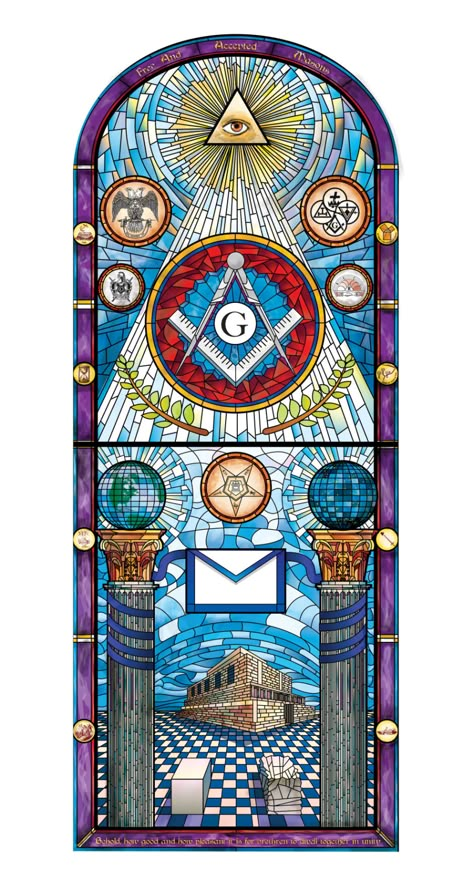 arrangement, geometry and number become more explicitly connected with the initiatic journey.
Nine is the square of three, and three occupies an important place in Masonic symbolism. The number appears repeatedly in Masonic instruction, including the symbolism associated with the Master Mason degree. Twelve, meanwhile, is frequently associated with completeness, fullness, and the organization of a whole.
The product of nine and twelve is one hundred and eight. This number also appears in several Eastern spiritual traditions, where it is associated with cycles, completeness, and spiritual practice. The significance attributed to it varies across those traditions, and its use in this Masonic interpretation should be understood as a comparative symbolic association rather than evidence of a single shared historical origin.
Within this framework, the one-hundred-and-eight-square pavement represents a more advanced reflection on the meaning of the world and the Mason's place within it. The number is associated with fulfilment, the completion of a path, and the overcoming of the passions.
The configuration can therefore accompany meditation on the third degree, whose central themes include symbolic death, transformation, and the possibility of renewal. In this reading, geometry no longer serves only to describe an ordered surface. It becomes a means of organizing reflection on inner development.
The source tradition also characterizes this arrangement as Pythagorean, connecting geometry with the numerical relationships through which order may be contemplated. That designation should be understood within the article's symbolic framework, rather than as a claim that the historical origins of the Masonic pavement can be traced directly to a specific Pythagorean design.
The movement from sixty-four squares to forty and then to one hundred and eight illustrates how a single symbol can support different levels of interpretation. The first arrangement emphasizes the world's elementary structure; the second emphasizes proportion and harmony; the third introduces associations with completion and inner transformation.
From Pattern to Meaning: How to Read the Pavement
These configurations are not necessarily competing explanations. They offer different ways of approaching the same symbol. A particular arrangement may support one interpretation, while another arrangement may encourage a different emphasis. The important point is not that every Mason must adopt all three numerical systems, but that geometry can become an additional instrument for reflection.
The number of squares is not always symbolically significant. In a physical Lodge, the dimensions of the room and the practical requirements of the floor may determine the pattern. On a tracing board, however, a deliberately selected arrangement can express an interpretive intention.
The distinction between practical construction and symbolic design returns us to the pavement's earliest history. The grid originally assisted the Mason in drawing and transferring plans. Its divisions served a concrete purpose. Later, those same divisions could become objects of contemplation, suggesting that geometry offers more than a way to construct material objects: it can also provide a language for considering order, proportion, and the relationship between parts and wholes.
At the same time, numerical interpretations should not be imposed upon every pavement without evidence. The sixty-four-square arrangement, the Golden Ratio configuration, and the one-hundred-and-eight-square design are interpretive possibilities. Their value lies in the reflections they invite, not in an assumption that every historical Lodge followed the same numerical scheme.
This approach allows the symbol to remain open to further inquiry. A Mason may begin with the visible contrast between black and white, then consider the geometric structure of the pattern, and finally reflect upon the relationship between that structure and his own experience. The symbol deepens as the observer's understanding develops.
Geometry provides a language for examining the pavement, but it does not replace the work of interpretation. Numbers and proportions can guide reflection, yet the Mason must still consider how the lessons of measure, balance, and awareness apply to his own life.
Geometry, Measure, and the Humanist Inheritance
The historical connection between the pavement and the drawing of plans gives its geometric symbolism a practical foundation. Geometry was not originally an abstract ornament added to the symbol. It belonged to the work the pavement helped accomplish.
The arrangement of squares made it possible to organize space, transfer a design, and preserve relationships between dimensions. These are practical expressions of order and measure. The Mason could use a grid to make a design intelligible and to ensure that its parts corresponded to one another.
As the pavement became a speculative symbol, this practical association offered fertile ground for philosophical reflection. The Mason could contemplate the relationship between the individual square and the larger pattern, between a measured part and the whole, and between a design conceived in the mind and its realization in the material world.
This interpretation is consistent with the broader humanist associations suggested by the word mosaic. The name's linguistic relationship with the Muses and the arts connects it to a tradition in which artistic creation, geometry, and the search for harmony were closely related. This does not prove that the Masonic pavement was created as a deliberate expression of humanist philosophy. Rather, it shows how its later interpretation could draw upon familiar ideas about pattern, proportion, and the ordering of diverse elements into a coherent whole.
The pavement also offers a useful distinction between order and uniformity. A mosaic is not formed by making every piece identical. Its pattern depends on the relationship between distinct elements. In the Masonic chequerboard, the black and white squares remain different, yet their arrangement produces a single surface.
This observation leads to a broader reflection on the nature of harmony. Harmony need not require the elimination of difference. It may instead depend upon the way differences are arranged, understood, and brought into relationship. The pavement's order emerges not because black and white become the same, but because both occupy their place within the pattern.
The same principle can be applied to the moral life. The Mason does not become a finished individual by denying every contradiction within himself. He develops through the effort to recognize his competing impulses, examine his actions, and bring greater measure to his conduct. His task is not to pretend that life has become uniform, but to work toward a more conscious and balanced response to its changing conditions.
This is one reason the Mosaic Pavement remains a powerful teaching symbol. It joins the practical world of measurement with the moral world of self-examination. Its geometry is visible, its contrasts are immediate, and its implications extend beyond the floor upon which it is represented.
The Pavement as a Symbol of Unity Within Diversity
The broader meaning of the word mosaic offers another way to understand the pavement. A mosaic is composed of many individual pieces that, taken together, form a larger image or pattern. The pieces retain their distinct identities, but their relationship to one another produces a coherent whole.
This meaning is particularly appropriate to Freemasonry, a fraternity that brings men with different experiences, occupations, temperaments, and perspectives into a shared institution. The differences among individuals do not disappear simply because they belong to the same Lodge. Rather, fellowship requires them to learn how to work together despite those differences.
The pavement's pattern provides a visual analogy for that process. The squares are not interchangeable in color, but each belongs to the same surface. The whole depends upon the presence and arrangement of its contrasting parts. In this sense, the pavement can be understood not only as a representation of opposition, but also as a reminder that diversity and unity are not necessarily incompatible.
This interpretation should not obscure the traditional moral lesson of good and evil. Instead, it extends the idea of contrast into the social life of the fraternity. Human beings do not enter a Lodge as identical units. They arrive with different histories and opinions, and they must learn to exercise mutual respect, discipline, and consideration if they are to build a meaningful common life.
The pavement does not suggest that every difference is easily resolved. Its squares remain distinct. Its unity is not the result of eliminating contrast but of arranging contrasting elements within a coherent design.
The lesson is therefore both individual and collective. Each Mason is called to examine his own contradictory nature, while the Lodge as a whole is called to cultivate an environment in which differences can exist without destroying fellowship. The individual learns to govern his passions; the fraternity learns to sustain its common purpose.
This understanding also connects the pavement to the practical heritage of the builder. A constructed work depends upon the proper relationship of its parts. A design may contain many separate elements, but the success of the whole depends upon the care with which those elements are measured, placed, and joined. The symbolic pavement translates that principle into a reflection on human character and communal life.
The mosaic thus becomes an image of unity achieved without uniformity. It reminds the Mason that a meaningful whole can contain difference, and that the presence of contrast does not necessarily mean the absence of order.
The Mosaic Pavement and the Work of Initiation
The Mosaic Pavement accompanies the Mason's journey not by supplying a complete explanation of existence, but by presenting a problem that must be revisited at different stages of understanding.
For the Entered Apprentice, the pavement can be read as a first encounter with the contrasting conditions of the world. The candidate sees a pattern of black and white and begins to consider the traditional lesson that human life is chequered with good and evil. This initial interpretation provides a foundation for self-examination and moral discipline.
As the Mason's understanding develops, the pavement can be considered in relation to geometry and proportion. The squares become more than contrasting surfaces; they form an ordered arrangement. The relationship between parts and whole suggests that the world may be examined through the principles of measure and structure.
A further interpretation considers the pavement in relation to inner transformation. The contrast between black and white is no longer merely a description of external circumstances. It becomes a reminder that the individual must work through uncertainty, recognize the limitations of his own judgment, and learn to respond to life's contradictions with greater awareness.
These readings need not be arranged as a rigid sequence in which one interpretation replaces another. The pavement remains available to the Mason throughout his Masonic life. A familiar symbol may acquire new significance as experience changes the questions a person brings to it.
The symbolic journey therefore does not depend upon discovering one final explanation that renders every other interpretation unnecessary. Instead, the symbol continues to support reflection. It invites the Mason to revisit the relationship between his principles and his conduct, between the world as he wishes it to be and the world as he encounters it.
This openness is one of the pavement's strengths. Its pattern is simple, but the human experience it represents is not. The black-and-white squares do not tell the Mason precisely how to respond to every moral difficulty. They remind him that difficulties exist, that his passions require discipline, and that wisdom demands a willingness to examine his own assumptions.
The pavement can be understood as a mirror, but a mirror does not perform the work of self-correction. It shows what is present and makes reflection possible. The Mason must still undertake the work of interpreting what he sees and deciding how to act.
In this respect, the Mosaic Pavement remains a living symbol rather than a fixed answer. Its meaning deepens as the Mason's experience and understanding develop, yet it never takes the place of the personal effort required to live according to the lessons of the Craft.
The Mosaic Pavement as a Way of Reading the World
The pavement is more than an image of a world divided into opposites. It is also an invitation to consider how the world is perceived and interpreted.
A person who sees only the black squares will have an incomplete view of the pattern. The same is true of someone who sees only the white. Each perspective identifies something real, but neither encompasses the whole. The complete design requires attention to the relationship between the contrasting elements.
This observation offers a useful lesson in discernment. Human beings often approach the world through partial experiences, personal expectations, and judgments formed under particular circumstances. We may focus on success while ignoring adversity, or become so absorbed in difficulty that we fail to recognize the possibility of improvement. We may judge an event according to one moment without considering the broader pattern of a life.
The pavement encourages a wider view. It does not erase the distinction between black and white, nor does it suggest that moral differences are meaningless. Instead, it asks the observer to recognize that individual elements belong to a larger field of experience.
To read the pavement is therefore to practice a form of attention. The Mason is invited to observe before judging, to distinguish without oversimplifying, and to consider how individual circumstances relate to a larger whole. This does not guarantee that every question will be resolved, but it can prevent a partial perspective from being mistaken for the complete truth.
The same principle applies to the relationship between historical evidence and symbolic meaning. The biblical description of Solomon's Temple does not establish that its main floor was a black-and-white mosaic. That historical limitation should be acknowledged. Yet it does not follow that the Masonic pavement lacks significance. The symbol's moral and philosophical value can be understood without converting a traditional association into a historical fact.
Discernment requires us to preserve both sides of this distinction. We should neither accept every traditional explanation without examination nor assume that a symbol loses its value whenever its historical origins prove uncertain. The pavement's history and its meaning are related, but they are not identical.
The symbol therefore teaches something about interpretation itself. It reminds us to distinguish evidence from inference, tradition from documented history, and a useful symbolic reading from a claim about what certainly happened in the past. This is not a rejection of tradition. It is a way of approaching tradition with care and intellectual honesty.
The pavement remains valuable precisely because it allows several dimensions of thought to meet. Historical inquiry explains how the symbol developed; geometry reveals its structure; ritual practice demonstrates how it is used; and moral reflection considers what it asks of the individual. Each contributes something to the whole, without any one dimension needing to erase the others.
An Old Emblem with Continuing Relevance
The Mosaic Pavement is among the oldest recognizable emblems of the Craft, appearing in early Masonic sources from the late seventeenth and early eighteenth centuries. Its history encompasses practical drawing surfaces, the emergence of the term Mosaick pavement, biblical explanations, ritual development, and the growth of moral and philosophical interpretations.
The evidence suggests that its early form was probably associated with a square or gridded surface used for laying out designs. The pavement may have been drawn temporarily on the Lodge floor, then erased after the work was completed. Its transformation into the permanent chequered carpet familiar in many modern Lodges remains incompletely documented, although the later development appears to have been associated with William Preston.
The name mosaic derives from a linguistic history connected with the Muses and the art of arranging small pieces into decorative patterns, not from Moses. The traditional connection with Solomon's Temple is likewise not established as an architectural fact by the biblical description in First Kings, which describes a wooden floor. The Temple association is best understood as part of the symbolic development of the pavement within Freemasonry.
These historical qualifications do not diminish the symbol. They clarify the difference between what can be established about its origins and what later generations have drawn from it. The pavement's standing in the Craft rests not on the certainty of every traditional explanation, but on its longstanding place in ritual and its continuing capacity to support moral reflection.
Its black-and-white pattern remains a powerful image of the human condition. It expresses the coexistence of opposing circumstances, the changing nature of experience, and the responsibility to govern one's passions. Its geometric arrangement invites reflection on order, proportion, and the relationship between individual parts and the whole. Its use in different rites reveals contrasting ways of relating the symbol to ritual action: as a surface to contemplate or as the ground upon which commitment is enacted.
The numerical interpretations associated with sixty-four squares, the Golden Ratio, and one hundred and eight squares offer further possibilities for reflection, provided that they are treated as interpretive frameworks rather than universal historical rules. They demonstrate how a familiar design can support different levels of symbolic inquiry, from the world's elementary structure to questions of harmony, completion, and inner transformation.
The pavement also reminds us that unity does not necessarily require uniformity. Its contrasting squares form a single surface without losing their distinct identities. In the same way, the Masonic fraternity brings different individuals into a common undertaking, asking them to practice discipline, mutual respect, and fellowship without pretending that every difference has disappeared.
Ultimately, the Mosaic Pavement is not simply an object to be seen. It is a symbol to be considered and a lesson to be practiced. It asks the Mason to recognize the world as it is, to examine the contradictions within himself, and to act with discernment amid circumstances that are rarely perfectly stable.
Whether the pavement is contemplated from a distance, represented on a Lodge Tracing Board, or crossed during ritual work, its central challenge remains the same. The Mason must learn to inhabit a world of contrasts without being consumed by them, to acknowledge difficulty without surrendering to it, and to pursue moral development without imagining that the work will ever be entirely complete.
The Mosaic Pavement offers no easy reconciliation and no final formula for living. It presents the world in its complexity and invites the Mason to meet that complexity with awareness, measure, and responsibility. Its enduring lesson is not that we can remove every dark square from the floor of life, but that we must learn how to walk through the world with understanding.
In the end, the Mosaic Pavement remains one of Freemasonry's most demanding symbols because it offers no answer that can replace personal effort. It keeps the essential question open: How can we inhabit duality without losing ourselves in it? How can we work within the world without allowing its contradictions to govern our character? And how can we continue, step by step, to build a life of greater balance upon ground that is never perfectly stable?
Sources and Further Reading
- The Square Magazine, “Masonic Miscellanies – The Mosaic Pavement.”
- Samuel Pritchard, Masonry Dissected (1730).
- A. C. F. Jackson, A Glossary of the Craft and Holy Royal Arch Rituals of Freemasonry (Lewis Masonic, 2008).
- Albert G. Mackey, Encyclopedia of Freemasonry and Its Kindred Sciences.
- The Edinburgh Register House Manuscript (1696).
- The Chetwode Crawley Manuscript (circa 1700).
- A Mason's Confession (circa 1727).
- The Wilkinson Manuscript (1727).
- The Bible, 1 Kings 6:15 and John 19:13 (King James Version).
- Ion Rajolescu, “The Mosaic Pavement in Freemasonry,” Nos Colonnes, including the accompanying discussion of the pavement as a symbolic reading of the world.


